union angry

by Reid Fitzsimons

I was an employee of New York State from 1986 to 2001 (Office of Mental Retardation and Developmental Disabilities). New York is a closed shop and employees are automatically associated with one of several public employee unions depending upon their position. My position required that I pay dues to the Public Employees Federation (PEF), the union representing professional, scientific, and technical employees. PEF represented positions ranged from nurses and medical providers to various therapists, educators, and accountants, to name a few. Note that I was not required to join the union, per se, only pay dues, which the state automatically deducted from every pay check. I personally refused to join the union for many years, which meant I was not eligible to vote in elections/referendums.

After a number of years I realized I could receive, as a non-member, a rebate of a portion of my dues, perhaps 20% if I recall correctly. In theory this was the amount that was used for political activism, though I was strongly suspicious of the basis of their calculation. This refund was in no way automatic but rather I had to personally write a letter making the request during a narrow window that occurred only once a year. Eventually circumstances at work compelled me to run for local President (Council Leader), but in order to do so I had to join the Union. I was quite pleased that I won the election by a 2 to 1 margin over the incumbent, this being in 1999. ...continue reading →
• 1 Comment

4-crucifix-gorrilla-714

by Barry King

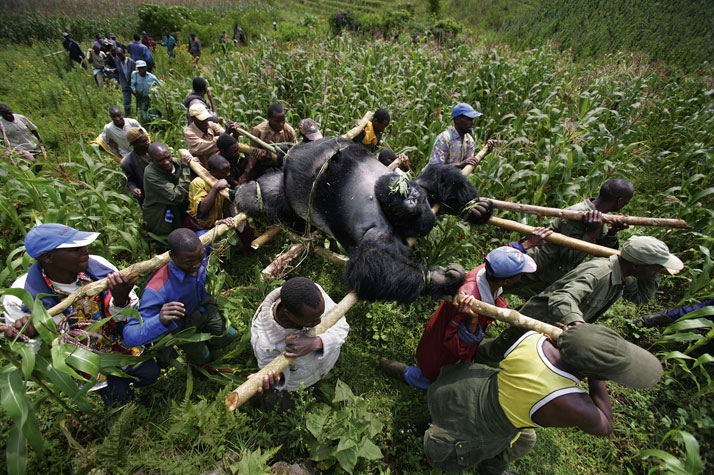
The acronyms mean: Liberal White European Nonsense about the Institute Congolais pour le Conservation de la Nature.

Here I sit in Uganda, just back from a visit to the Virunga National Park in Congo. After reading this article in Foreign Affairs http://fam.ag/1EwFADa  I have figurative steam rising from my ears, like the volcanic smoke from Nyiragongo and Nyamuragira. I'd like to offer my observations about it. Disclosure: I advise and assist ICCN with the operation and maintenance of their airplanes, so I may have a bias in favor of the work they are doing with those planes. I'll insert my own comments between quotes from the article, which is a critique of the recent Oscar-nominated film "Virunga", and implicitly, of ICCN.

...continue reading →

• 4 Comments

rodeo us flg

by Reid Fitzsimons

Recently Rudy Giuliani suggested Barak Obama doesn’t love America, and predictable outrage and fireworks ensued. So, was he right or does Barak Obama love America? We can answer that question with a parable of sorts. A sensitive young woman gives herself sexually to an older man. Once he has been satisfied she anxiously asks if he loves her. He hesitates for only a moment then replies, “Of course I love you, now what’s your name again?” To this guy love is part of his thoughts as much as contemplation over whether Pluto is a planet or a lesser body, but he does love what he can take from her. The concept of love of country is more than foreign to progressives like Obama, it is anathema.

Love of country evokes images and feelings that appeal to rednecks and malleable yokels- freedoms and remembrances of those who died defending them, jets flying overhead in formation before a sporting event, patriotic songs. Love of country involves a chill going up one’s spine when the flag passes by and a choked up sensation when hearing the words of the founders when played against the backdrop of certain music. Ronald Reagan, with a lowly bachelors degree from a small regional college, loved America.

Progressives, especially one as sophisticated and nuanced as our president, apportion love differently. While nobody can claim they don’t love their children and perhaps even their spouses as much as anyone, their love is otherwise reserved for higher level entities- elegant dining, fine wine, celebrities, expensive clothing, exotic vacations, power and, of course, themselves. ...continue reading →

by Barry King

In certain ambiguous situations of deadly violence, in which a black victim is killed by a white killer but there’s no evidence about whether the killers’ motives included racism, the politically correct thing to say is: that violence was not just “random”; it was an example of (racial) prejudice in action.

On the other hand, in certain less ambiguous cases, in which the motives are clear (such as: “We are Muslims, they were Jews or Christians, and we killed them *because* we are Muslims and *because* they were Jews or Christians), then the politically correct thing to say is: that violence was just “random”; it was not an example of (religious) prejudice in action.

Observations about those situations: 1. Both are different from what you might expect if the position statements were derived rationally from the available evidence, and 2. The premises and logic underlying each position contradict the premises and logic of the other, which is not a situation one should expect if both were derived rationally.
Tentative conclusions: 1. neither of those politically correct positions is rationally determined. 2. One person’s “bigotry” can sometimes be another person’s “righteous indignation”, and that sword can cut both ways. 3. If people are to be invited to get off their “high horses”, that invitation will be most irenic if it is addressed broadly rather than narrowly.


Blues Brothers 4

by Reid Fitzsimons

During the 2012 Democratic convention a delegate from NY, Julia Rodriguez, fantasized in a video interview that she would like to kill Mitt Romney (“If I see him I would like to kill him”). An internet search for this incident revealed minimal follow-up, mostly that a Secret Service representative said, “We are aware of it,” and the agency is “taking the appropriate follow-up steps.” Beyond this the internet trail went cold so presumably Delegate Rodriguez returned to the Bronx uneventfully and is not in a Federal slammer subsisting on multigrain bread and Evian bottled water (for disclosure purposes I should mention I worked in a Federal Prison from 1982-1986).

Conservatives, and perhaps other sentient beings, hear of this type of thing and see a dichotomy. If a Republican delegate had said something similar of Obama, one could almost envision the climactic scene in The Blues Brothers as multiple SWAT teams converged on Jake and Elwood at the Cook County Assessor’s Office (the above photo if you aren't familiar with the movie). In reality it is unlikely a conservative would think such a sentiment let alone say it- while we are certainly not free of emotions of the moment we are generally constrained by the tradition of civility in discourse and rationality of thought. There are plenty of things I would like to either ask or say to our president were I to see him, but murderous fantasy is more the domain of progressives. ...continue reading →

noble rouss


by Barry King

While setting the stage for the French version of liberty, equality, and fraternity, Rousseau said that savages were noble, and that humans generally were naturally and inherently good (religious opinions to the contrary notwithstanding). When asked why he would believe such a thing, in the absence of any evidence for it, he answered that the idea just popped into his head one day, which is pretty much the only available answer to that question. The idea popped into Rousseau's head, and began it's process of decimating western civilization, without his ever having lived in Africa, and long before Europe itself descended into a darkness darker than any ever seen in Africa, in the middle of the 20th century. Philosophically, this notion is pretty much sine qua non for Rousseau's process of becoming "enlightened" and "humanist", and for leading so many others to follow him in that direction.

It's hard to articulate exactly what the problems are, with Rousseau's humanism. But among them is this one: it leaves unanswered the question, when life proves to be full of problems, at whom are we going to point our fingers of blame? After all, everybody else is naturally and inherently good, just like we are. So where in the world is all of this "evil" coming from? Since Rousseau, the best available answer from his point of view has generally been, "Don't ask, it's an embarrassing question". ...continue reading →

• 1 Comment

obamatux

by Reid Fitzsimons

One of the less uplifting constructions in polemic discourse is the one using, “Oh yeah, well…” Such as, upon losing at rock-paper-scissors, the defeated child exclaims, Oh yeah, well my father has a bigger SUV than yours!” Usually one doesn’t find much enlightenment in such a retort. I have an in-law who is a decent sort but a dogmatic, knee-jerk type progressive, quite willing to share his opinion regardless of the circumstance. Sometime during the 2008 presidential primary season he asked my thoughts on Mitt Romney, to which I lamely replied something like, “He seems like a nice enough guy.” His response was a swift, “Oh yeah, well did you know he’s a Mormon and Mormons are for polygamy.”

The “Oh yeah, well…” rebuttal is fairly low in the hierarchy of intellectualism and thoughtfulness. Nevertheless, one need not be an undereducated nitwit to use it: my in-law in this case is a PhD astrophysicist at MIT. In regards to polygamy I’m fairly certain the nebulous masters that determine the course of progressivism will declare it a cause-celebre in the near future. Hence my in-law will quickly evolve and soon enough will be shaking his head and perhaps fists at the intolerant hate-filled polygamyphobes. ...continue reading →

worship_12

by Barry King

President Obama called recent years of record federal spending, including billions of Keynesian "stimulus" using borrowed money, "mindless austerity" - as though if he had his way such spending would be even more prodigal. That's hard to imagine, but he can apparently imagine it. Americans are consuming all of their income, and then consuming more and spending more long after they should stop, They are able to continue that for now only by borrowing from China, leaving it to their grandchildren to repay those loans to China with interest. That can't continue much longer, and the only reason it can happen at all is because 21st-century Chinese, unlike 21st-century Americans, produce more than they consume and save the difference, so that their net savings are available to be loaned to Americans - and invested in Africa.

If the President thinks current US federal spending can be described as "mindless austerity", that means he wants to spend even more, in support of American consumption of goods and services. And of course there may well be enough American voters who like that idea, to keep him and politicians like him in power for a while longer. In that milieu, China's surpassing the US as the world's largest and most powerful economy is not only inevitable: it will happen very quickly now, more quickly than almost anyone expects. Here in Africa, that process is more clearly visible - I have been meaning to write up a report of what I saw during a recent visit to Beira, Mozambique - but I suppose there in the USA it might remain out of sight and out of mind for a little while longer. ...continue reading →

by Barry King

On June 4, 2009, only a few months into his presidency, US President Obama gave a major speech about US relations with the Muslim world, at Al Azhar University in Cairo, Egypt. Reuters reported that the President’s objective in the speech was to “repair ties that were severely damaged under his predecessor George W. Bush.” One sign of that damage was that at the end of Bush’s term, only 27% of Egyptians reported having a favorable view of the USA. Today in 2015, after the first six years of President Obama’s tenure, that approval rating in Egypt has dropped an additional 17 points, to the current abysmal 10% (according to Pew Research). That’s the real-world result, so far, of Obama’s pressing of his metaphorical “reset button”.

On January 1, 2015, only a few months into his presidency, Egyptian President Al-Sisi gave another speech in the same venue, at Al Azhar. ...continue reading →

ddt

by Reid Fitzsimons (note: this article is generally critical of Silent Spring but is reasonably balanced and discusses a number of redeeming aspects of the book and author)

First some basics- Silent Spring is a book written by Rachael Carson and published in 1962. It primarily discussed the negative environmental effects that liberal use of chemicals, especially in the form of herbicides and pesticides, had on the environment. It was and continues to be considered a landmark book and is largely viewed as the progenitor of the modern environmental movement, and all that it entails. As such, the book is often mentioned disparagingly among conservatives. I was no stranger to mocking the book and, hypocritically, was armed only with references made by others- I hadn’t actually read it. Hence one day I figured out how to download it for free in one format, convert it to a .pdf, and load it on to my Nook.

Fortunately Silent Spring proved to be pretty readable and not too long at a bit over 200 pages. Later I am going to assert there is a conservative interpretation possible of the book, but before that a brief aside. I just happened to review a Common Core literature book (Timeless Voices, Timeless Themes) used in the local high school, which includes the introductory chapter of Silent Spring (this is considered literature?). Not surprisingly the associated comments are highly favorable and slanted, to say the least, including, ‘…a chilling and well-documented warning about the dangers of pesticides.” Nothing remotely negative is offered, including any discussion of the millions (literally) of children who have perished likely due to self-serving and shortsighted environmental policies largely initiated by Silent Spring. But what the heck, one can’t dispute Common Core. ...continue reading →