Environmentalism

2 Comments

By Reid Fitzsimons

Greta Thunberg achieved, at a young age, global celebrity as a professional protester and activist. She did not find activist fame in the usual way- first become a celebrity (eg actor or author) then exploit their status to preach about whatever they perceive as “injustice-” rather she ascended to the top by being perpetually and publicly aggrieved. She was born in Jan. 2003 in Stockholm, Sweden to parents of moderate fame: her mother is an opera singer and her father an actor and manager and seemingly are of at least moderate affluence. Thunberg apparently became depressed and anorexic when she was 11, perhaps over “climate change” (“I saw and heard these horrible stories about what humans had done to the environment, and what we were doing to the climate, that the climate was changing…”) and was soon thereafter “diagnosed” with Asperger’s syndrome, as compared to simply being a troubled child.


Thunberg first appeared on the radar locally in 2018 when she was 15 via her Strike School for Climate campaign, where she skipped classes on Fridays to protest outside of the Swedish parliament. This led to invitations to speak at various rallies in Europe. A year later she was awarded global celebrity status by being a passenger on a hi-tech/ low carbon emissions yacht crossing the Atlantic Ocean and arriving at NY City to speak at a variety of climate protests and “strikes.” The culmination of this adventure was a speech she gave in Sept. 2019 at the UN, where she chastised the ostensibly climate concerned establishment with a speech that included “You have stolen my dreams and my childhood with your empty words. And yet I’m one of the lucky ones. People are suffering. People are dying. Entire ecosystems are collapsing. We are in the beginning of a mass extinction, and all you can talk about is money and fairy tales of eternal economic growth. How dare you!” It was noted by critics that sailing to NY rather than flying- making a statement, so to speak- was a bit silly because others had to fly across the Atlantic to deal with the logistics of the yacht. There was also cynicism in the fact that the vast majority of the world couldn’t reasonably sail across an ocean, let alone in an approx. $3 million yacht co-captained by a Prince of Monaco.
state

by Barry King, November 28 2015

Thanks to Reid's son Forest for introducing me to this book. If you buy it, or buy anything else from amazon.com, please shop at smile.amazon.com instead of www.amazon.com, and select The Virunga Fund as your beneficiary. It won't increase your price, but amazon will make a donation to Virunga.

http://smile.amazon.com/Seeing-like-State-Certain-Condit…/…/

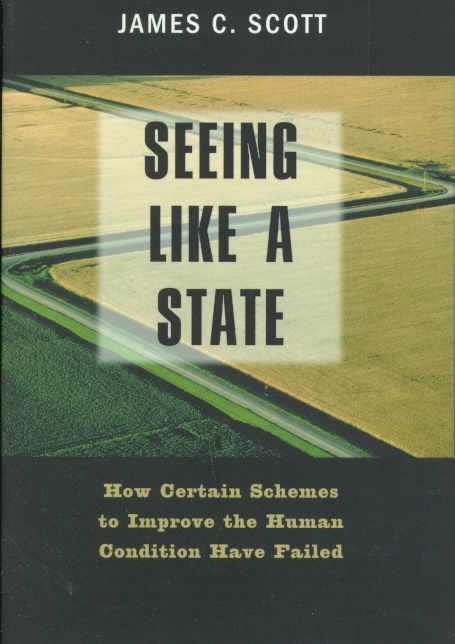
Book review: Seeing Like a State: How Certain Schemes to Improve the Human Condition Have Failed, by James C. Scott.

Prototypical scheme: A wild forest was designed by God, or by Darwinian evolution, to "succeed" as an ecosystem capable of sustaining a bio-diverse assortment of plant, animal, insect and bird species (and many other kinds). Modern "scientific" forestry, on the other hand, in its early stages, focused on maximizing board-feet of lumber produced, and chose mono-culture: a whole forest of trees of a single species, planted in rows. Many such projects worked for a few years, then failed as the whole forest ecosystem collapsed for unforeseen reasons involving complex interdependencies. The key insight is: these projects, and many others like them, were promoted as "modern", "scientific" and "rational", but were nevertheless unsustainable.

...continue reading

cc

by Barry King

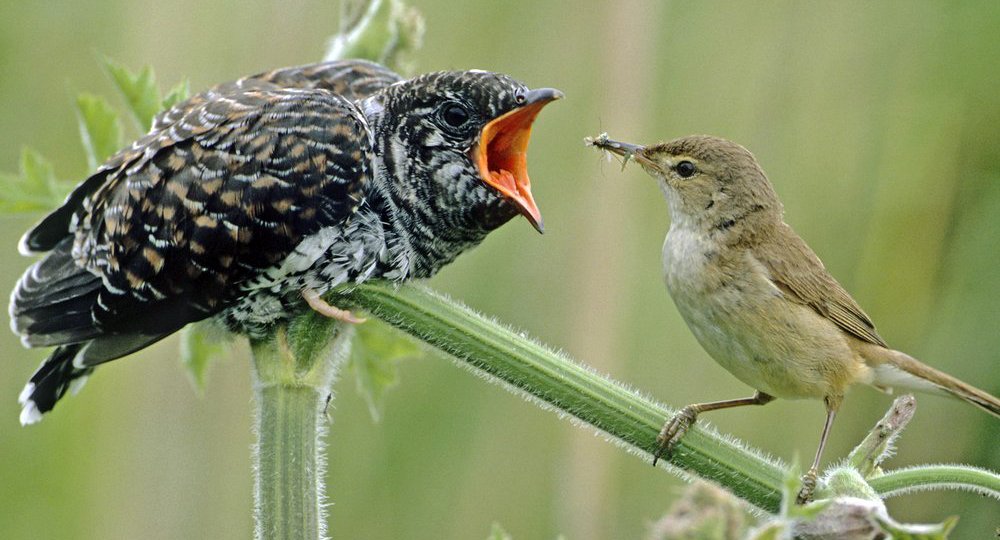
For lovers of science and of nature, parasitism is a fascinating topic. An important detail is the complexity of the definition of "success" for the parasite, who prefers to rely on the productivity of others rather than on his own productivity (the cuckoo prefers not to be bothered by the hard work of building a nest, incubating eggs, and feeding chicks, so she just lays her eggs in someone else's nest.) The "success" of parasitism has an obvious strategic limitation in this consequence, that if the parasite is too "successful" the host is overwhelmed and goes extinct. Then the parasite goes extinct because it had become fatally dependent on a now-extinct host. Cuckoos can get away with it sustainably because they are parasitic only gently and on a wide variety of other species rather than on just one. A forest with cuckoos is more (bio)diverse than one without, but if the cuckoos collectively are not careful they will end up subtracting both their hosts and themselves from the biodiversity gene pool. That's why infectious organisms that cause 100% fatality in their hosts are extremely rare: their evolutionary tactic is strategically suicidal within just 1 or 2 generations. In human politics and economics, the analog to parasitism is misleadingly called "rent-seeking" (https://en.wikipedia.org/wiki/Rent-seeking) I guess it's a good thing that we humans are not aggressively parasitic organisms - or are we?

1 Comment

4-crucifix-gorrilla-714

by Barry King

The acronyms mean: Liberal White European Nonsense about the Institute Congolais pour le Conservation de la Nature.

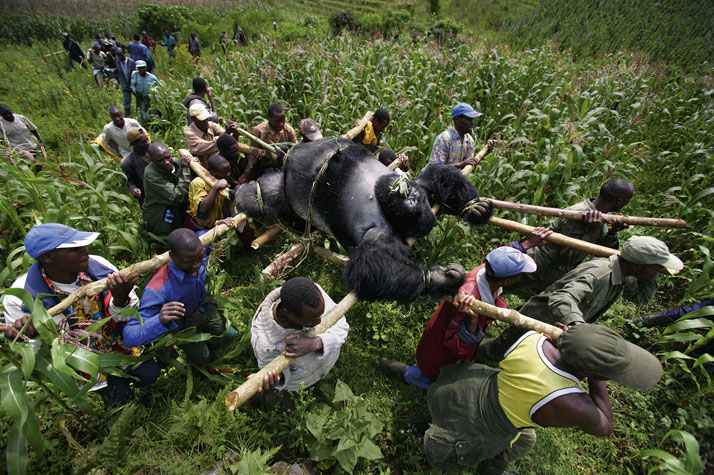
Here I sit in Uganda, just back from a visit to the Virunga National Park in Congo. After reading this article in Foreign Affairs http://fam.ag/1EwFADa  I have figurative steam rising from my ears, like the volcanic smoke from Nyiragongo and Nyamuragira. I'd like to offer my observations about it. Disclosure: I advise and assist ICCN with the operation and maintenance of their airplanes, so I may have a bias in favor of the work they are doing with those planes. I'll insert my own comments between quotes from the article, which is a critique of the recent Oscar-nominated film "Virunga", and implicitly, of ICCN.

...continue reading

ddt

by Reid Fitzsimons (note: this article is generally critical of Silent Spring but is reasonably balanced and discusses a number of redeeming aspects of the book and author)

First some basics- Silent Spring is a book written by Rachael Carson and published in 1962. It primarily discussed the negative environmental effects that liberal use of chemicals, especially in the form of herbicides and pesticides, had on the environment. It was and continues to be considered a landmark book and is largely viewed as the progenitor of the modern environmental movement, and all that it entails. As such, the book is often mentioned disparagingly among conservatives. I was no stranger to mocking the book and, hypocritically, was armed only with references made by others- I hadn’t actually read it. Hence one day I figured out how to download it for free in one format, convert it to a .pdf, and load it on to my Nook.

Fortunately Silent Spring proved to be pretty readable and not too long at a bit over 200 pages. Later I am going to assert there is a conservative interpretation possible of the book, but before that a brief aside. I just happened to review a Common Core literature book (Timeless Voices, Timeless Themes) used in the local high school, which includes the introductory chapter of Silent Spring (this is considered literature?). Not surprisingly the associated comments are highly favorable and slanted, to say the least, including, ‘…a chilling and well-documented warning about the dangers of pesticides.” Nothing remotely negative is offered, including any discussion of the millions (literally) of children who have perished likely due to self-serving and shortsighted environmental policies largely initiated by Silent Spring. But what the heck, one can’t dispute Common Core. ...continue reading