1 Comment

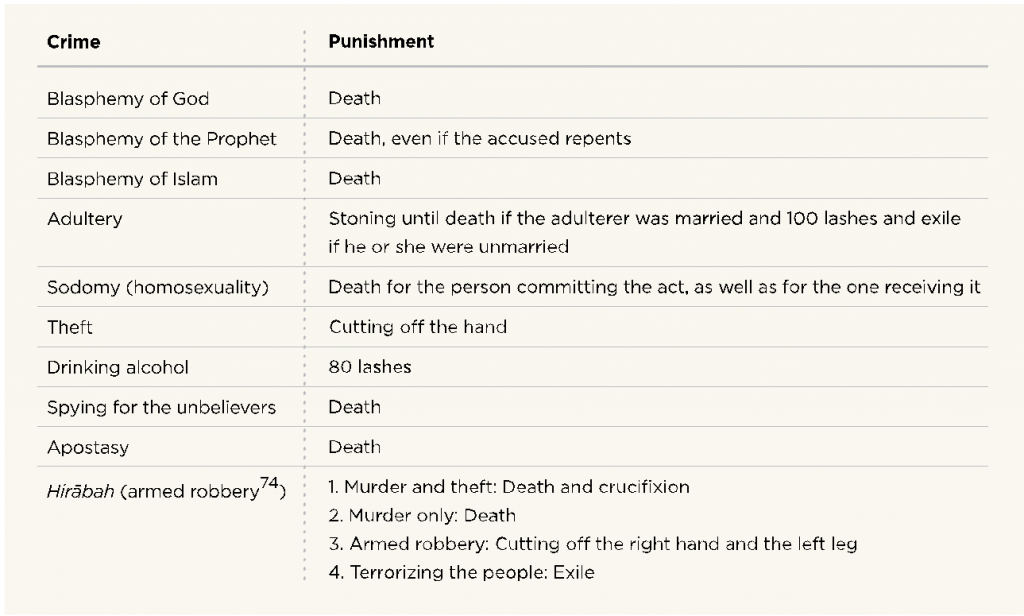
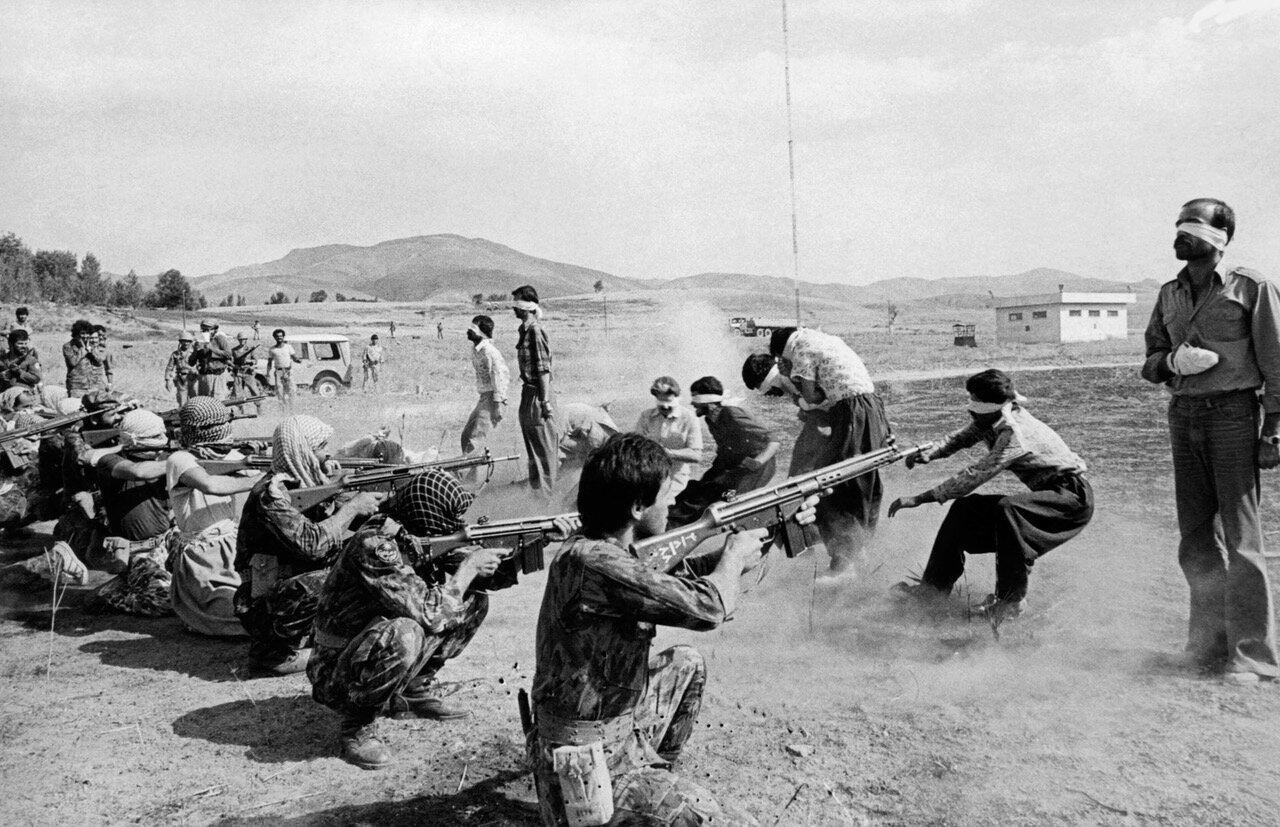
Below is a summary of the Huddud laws, followed by blasphemy laws, and far below is a review of post-WW2 religious related killing in text form:

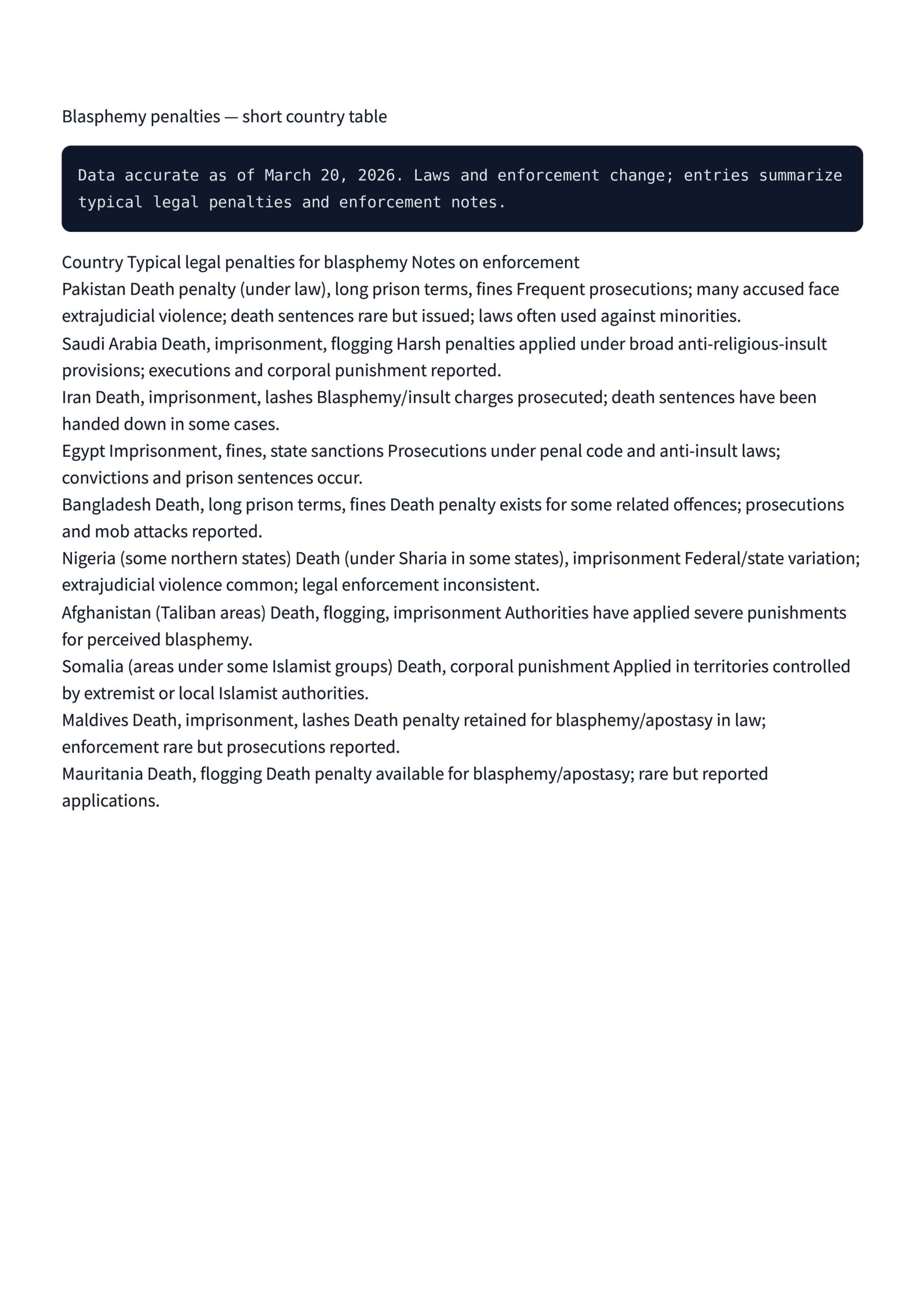
Below is a summary of country by country blasphemy laws (and well below is a text summary of post-WW2 killing by religion):

Below is a concise incident-by-incident table (major post-WWII events) using inclusive attribution rules you approved: I include state-led mass killings when perpetrators can be plausibly identified with a religion or sect (e.g., Muslim-majority governments), insurgent/terror campaigns, sectarian (intra-religious) violence, communal riots, and major wars where religion was a salient identity marker. Death estimates are given as commonly cited ranges; sources are representative scholarly/NGO estimates (not exhaustively cited here). Totals at the bottom sum the midpoints of ranges for a rough comparative view — treat as indicative, not definitive.

Table columns: Event — Years — Estimated deaths (range) — Primary perpetrator identification — Brief note

  • Partition of India/Pakistan — 1947 — 200,000–2,000,000 — Hindus/Muslims (communal actors on both sides) — mass communal violence during partition and migration.
  • Indonesian anti-communist killings — 1965–66 — 500,000–1,000,000 — Mixed (some Muslim-majority actors among perpetrators) — anti-communist/anti-left purge; motives mainly political but perpetrators in a majority-Muslim country.
  • Algerian War (civilian deaths & reprisals) — 1954–1962 — ~200,000–300,000 — Algerian nationalists/French state (Muslim Algerian population central) — anti-colonial war with large civilian toll.
  • Bangladesh Liberation War (and associated massacres) — 1971 — 300,000–3,000,000 — Pakistani state forces (Muslim-identified Pakistan) — targeted killings including many Hindu civilians; political/ethnic drivers.
  • Iran–Iraq War (civilian+military deaths attributable to state actors) — 1980–1988 — ~500,000–1,000,000+ — Iraqi state (Sunni-dominated Ba'ath) and Iranian state (Shia theocratic state) — interstate war with sectarian overlay.
  • Cambodian genocide (Khmer Rouge) — 1975–1979 — 1,500,000–2,000,000 — Secular/communist (not religious) — included here only as contrast (ideology, not religion, primary).
  • Nigerian/Boko Haram insurgency & related violence — 2009–present — 30,000–300,000 (varies by period) — Islamist militants (Sunni) and counter-operations — terrorism, insurgency, communal displacement.
  • ISIS / ISIL campaigns (Iraq, Syria, region) — 2013–2019 (major peak) — 100,000–500,000+ (including war deaths in Iraq/Syria where ISIS was a major actor) — Islamist (Sunni) militants — mass killings, executions, terror campaigns, and battlefield deaths.
  • Taliban insurgency & associated violence (Afghanistan, including 1996–2001 regime and post‑2001 insurgency) — 1994–present — 100,000–300,000+ (decades of conflict) — Islamist (Sunni) — insurgency, terrorist attacks, and state repression.
  • Iran post-1979 state repression and Iran-backed militias (incl. Iraq/Iran tensions, sectarian proxies) — 1979–present — tens of thousands–hundreds of thousands (overlaps with Iran–Iraq War and regional proxy wars) — Shia-identified state and proxies.
  • Lebanese Civil War (sectarian) — 1975–1990 — ~120,000–150,000 — Mixed (Christian, Sunni, Shia, Druze militias) — complex sectarian/ political conflict.
  • Bosnian War (ethnic cleansing, Srebrenica genocide) — 1992–1995 — ~100,000–200,000 — Serb (mostly Orthodox Christian nationalist) and others; Bosniak victims (Muslim) targeted — ethnic/territorial conflict with religious identity salient.
  • Rwandan Genocide — 1994 — ~500,000–1,000,000 (commonly ~800,000) — Hutu extremists (ethnic, not primarily religious) — included as contrast (churches implicated in incidents; religion not primary driver).
  • Myanmar (Rohingya persecution, 2012 onward; 2017 military campaign) — 2012–present (2017 peak) — thousands–tens of thousands killed; ~700,000+ displaced — Buddhist-majority state actors and Buddhist nationalist mobs — ethnic cleansing/possible genocide against Rohingya Muslims.
  • Sri Lankan civil war & anti-Tamil violence (Sinhala-Buddhist nationalism interacting with Tamil separatism) — 1983–2009 (with 2009 final offensive) — ~80,000–100,000+ — Sri Lankan state (majority Sinhala Buddhist) vs. LTTE (Tamil) — ethnic/territorial war with religious/ethnic overlap.
  • Gujarat riots — 2002 — ~1,000–2,000 — Hindu mobs (and alleged state complicity) — communal violence targeting Muslims.
  • 1984 anti-Sikh riots (India) — 1984 — ~2,000–3,000 (estimates vary) — Hindu mobs/state actors — communal pogrom after Indira Gandhi’s assassination.
  • Central African Republic (Christian militias vs Muslim Seleka) — 2012–2014 (ongoing cycles) — ~5,000–10,000+ deaths and large displacement — mixed Christian and Muslim militias.
  • Northern Ireland (The Troubles) — 1969–1998 — ~3,500 — Protestant vs Catholic sectarian/paramilitary political conflict.
  • Other Islamist terrorism globally (al-Qaeda, regional affiliates) — 1990s–present — tens of thousands (combined, incl. 9/11 indirect war deaths many more) — Islamist militants (Sunni).
  • Other communal/sectarian episodes worldwide (e.g., pogroms, riots in various countries) — cumulative tens of thousands — mixed perpetrators across religions.

Rough summed midpoints (illustrative, non-precise):

  • Events where perpetrators are predominantly Muslim-identified (includes Islamist militants, Sunni/Shia state/sectarian actors, and major wars with Muslim-state perpetrators): combined midpoint estimate (sum of listed relevant midpoints) is on the order of several million (rough indicative midpoint total ~4–8 million), driven largely by Iran–Iraq War, Bangladesh 1971, ISIS/Taliban era conflicts, partition violence partial share, and other insurgencies.
  • Events where perpetrators are predominantly non-Muslim-identified (Hindu, Buddhist, Christian, secular nationalists): combined midpoints also number in the millions when including partition (shared), Cambodian genocide (secular), Bosnian/Serb actions, Myanmar (Buddhist actors), Sri Lanka, and others (~3–6 million indicative).
  • Secular/ideological regimes (e.g., Khmer Rouge) and ethnic conflicts where religion was secondary remain major components of total deaths.

Bottom line (concise):

  • Using inclusive rules you requested, it is plausible that Muslim-identified perpetrators (state and non-state, including intra-sect Sunni vs Shia violence) account for a plurality of violent deaths tied to religiously-identified actors since WWII — largely because many high-fatality conflicts in the late 20th and early 21st centuries involved Muslim-majority states or Islamist groups.
  • This conclusion is highly sensitive to attribution choices, event inclusion/exclusion, and death-estimate sources; different reasonable rules can yield different pluralities or none at all.

by Reid Fitzsimons

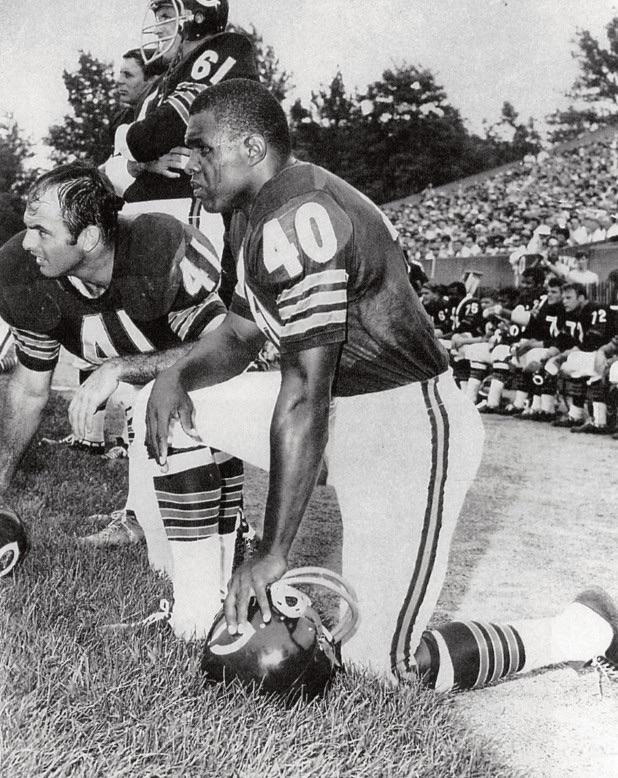
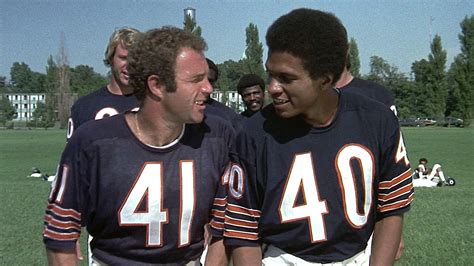
I recently watched the 1971 made-for-TV movie Brian’s Song for the first time since 1971. It was amazing how I remembered scenes and even individual lines after 55 years. Brian was Brian Piccolo, an extroverted rookie running back with the Chicago Bears in the mid-60s, who became great friends with Gale Sayers, the soft-spoken and extraordinarily talented fellow rookie running back. The former was 2nd string, and the latter won awards and accolades. Piccolo was white with a trace of redneck while Sayers was black, and the movie was primarily about the deep relationship they developed. There was a lot of football itself and the love of playing it, as compared to the love of money and celebrity in the decades since.

It was a positive movie that took place during a time when Jim Crow was receding, and black and white people could indeed find not just racial tolerance, but go well beyond it: as Piccolo was hospitalized dying of cancer at the age of 26, Sayers had to attend an awards banquet, and as he received an award for bravery (overcoming a severe injury) he declared, “I love Brian Piccolo,” followed by clarifying who truly was brave. This was the movie that gave men permission to cry.

1 Comment

by Reid Fitzsimons (note this article was first published at the American Thinker: https://www.americanthinker.com/articles/2026/01/progressives_give_them_just_enough.html)

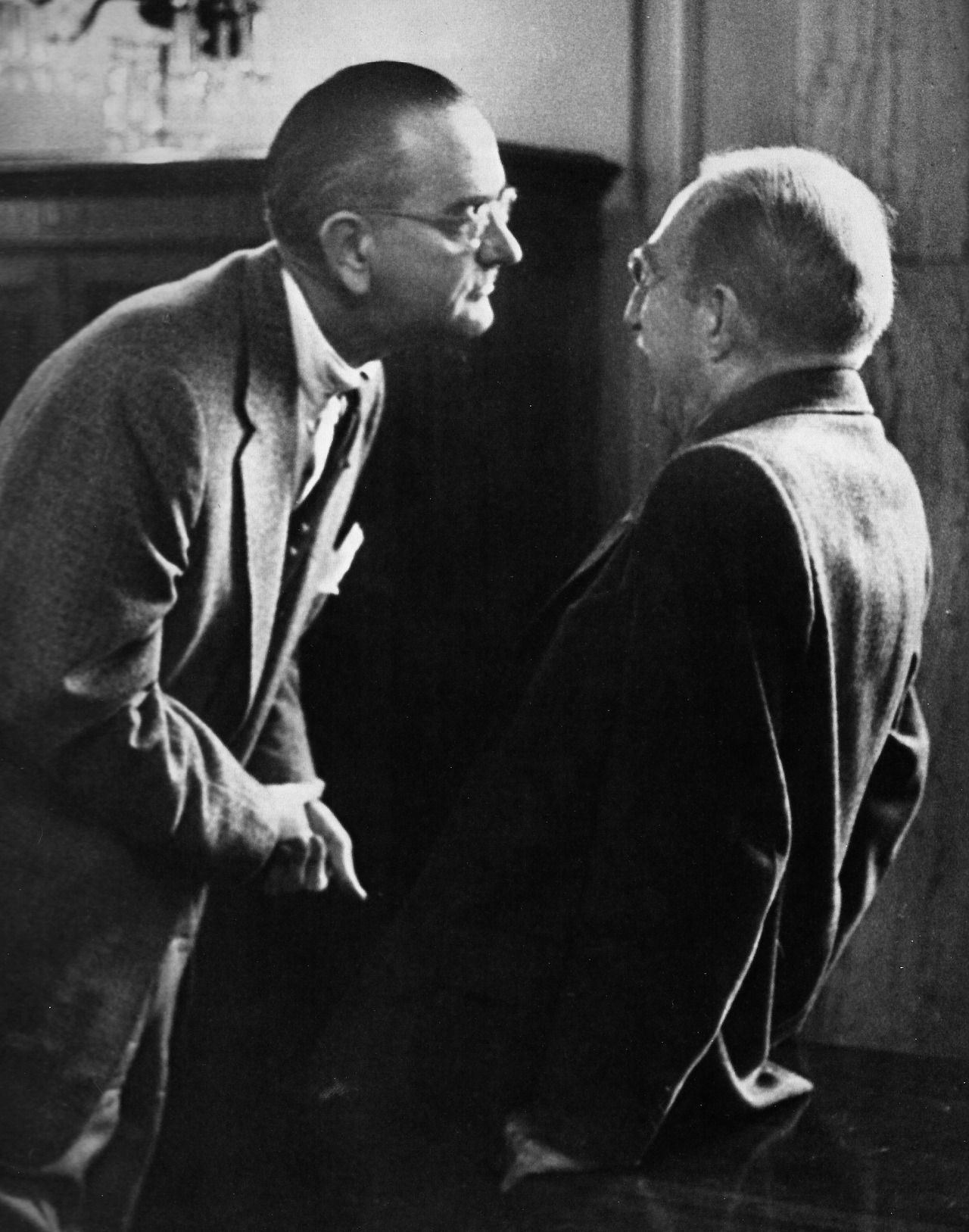
Affluent progressives have the ongoing challenge of maintaining their wealth and status while keeping up appearances of benevolence and compassion. Regarding race, in post-WW2 America, as the old use of intimidation by Democrats to manage black people receded more subtle strategies were needed. These were mentioned by then Senate Majority Leader Lyndon Johnson (LBJ, D-TX) who, in discussing the 1957 Civil Rights Bill with Sen. Richard Russell (D-GA) said: "These Negros, they're getting pretty uppity these days and that's a problem for us since they've got something now they never had before, the political pull to back up their uppitiness. Now we've got to give them a little something, just enough to quiet them down, not enough to make a difference..."

LBJ as Senate Majority Leader; he had a reputation for being physically dominating, called "the Johnson Treatment"

To put it another way, Johnson and his peers had to find a way to keep black people disenfranchised while appearing to empower them, and ultimately ensure they voted Democrat in perpetuity. Fooling and manipulating a targeted demographic is certainly not unique in history and this progressive approach proved to work spectacularly: it remains ubiquitous almost 70 years later. Autonomous and competent people are not amenable to manipulation, hence it became necessary to make the targeted demographic embrace the opposite: helplessness, dependency, and victimization.

2 Comments

by Reid Fitzsimons (note an edited version of his article appeared in the American Thinker on-line magazine: https://www.americanthinker.com/articles/2025/11/at_2025_11_17.html)

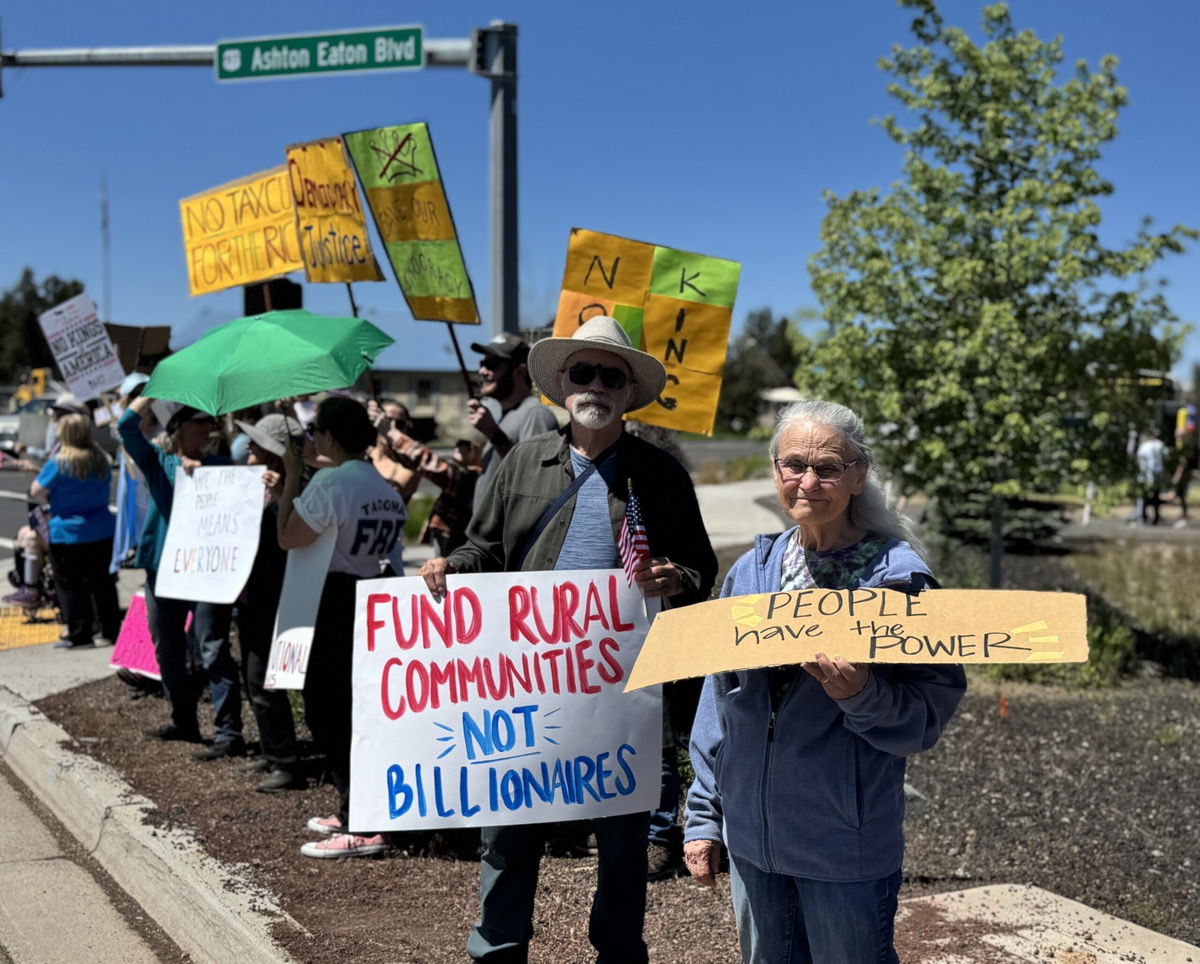
On Oct. 18, 2025 a second round of anti-Trump demonstrations under the banner “No Kings” occurred throughout the US, with several million participants in total. Whether they are pampered hippies (or wannabe hippies) long past their sell-by date desperately trying to relive their youth or intrepid defenders of democracy, No Kings is an interesting phenomenon that warrants a closer look.

3 Comments

By Reid Fitzsimons

Greta Thunberg achieved, at a young age, global celebrity as a professional protester and activist. She did not find activist fame in the usual way- first become a celebrity (eg actor or author) then exploit their status to preach about whatever they perceive as “injustice-” rather she ascended to the top by being perpetually and publicly aggrieved. She was born in Jan. 2003 in Stockholm, Sweden to parents of moderate fame: her mother is an opera singer and her father an actor and manager and seemingly are of at least moderate affluence. Thunberg apparently became depressed and anorexic when she was 11, perhaps over “climate change” (“I saw and heard these horrible stories about what humans had done to the environment, and what we were doing to the climate, that the climate was changing…”) and was soon thereafter “diagnosed” with Asperger’s syndrome, as compared to simply being a troubled child.

Thunberg first appeared on the radar locally in 2018 when she was 15 via her Strike School for Climate campaign, where she skipped classes on Fridays to protest outside of the Swedish parliament. This led to invitations to speak at various rallies in Europe. A year later she was awarded global celebrity status by being a passenger on a hi-tech/ low carbon emissions yacht crossing the Atlantic Ocean and arriving at NY City to speak at a variety of climate protests and “strikes.” The culmination of this adventure was a speech she gave in Sept. 2019 at the UN, where she chastised the ostensibly climate concerned establishment with a speech that included “You have stolen my dreams and my childhood with your empty words. And yet I’m one of the lucky ones. People are suffering. People are dying. Entire ecosystems are collapsing. We are in the beginning of a mass extinction, and all you can talk about is money and fairy tales of eternal economic growth. How dare you!” It was noted by critics that sailing to NY rather than flying- making a statement, so to speak- was a bit silly because others had to fly across the Atlantic to deal with the logistics of the yacht. There was also cynicism in the fact that the vast majority of the world couldn’t reasonably sail across an ocean, let alone in an approx. $3 million yacht co-captained by a Prince of Monaco.

3 Comments

by Reid Fitzsimons

There is a sense of personal liberation in being unburdened by thought and the pursuit of knowledge. If one can avoid uncomfortable experiences and banish from their sphere annoyances like different perceptions and opinions, they are freer to engage in self-gratification and pleasure, such as watching streaming TV, caressing an Iphone, sipping crafted coffees, getting tattoos, attending various protests, and all-in-all having a good time. If someone can dispel and render moot disagreement with their world view using a single word or mindless phrase, so much the better. After all, having to come up with a well-reasoned argument to support a position can be hurtful to the brain of certain people.

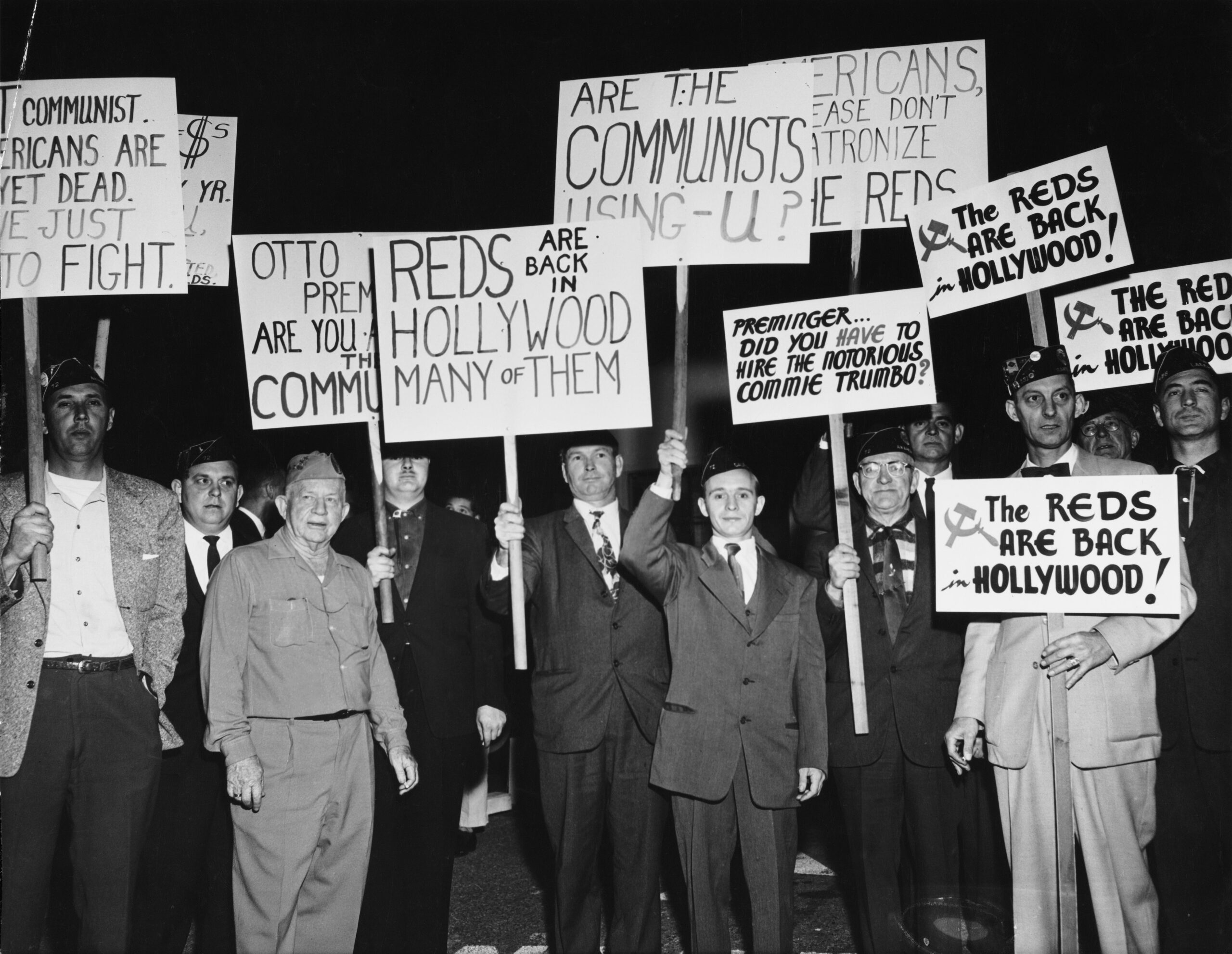
This approach goes back to ancient times and continues to the present. In the historic dark days of Christianity, for example, one merely had to make the accusation of heresy or witchcraft and the person who didn’t fit comfortably in your insulated world was gone, often literally. Or in the current dark days of Sharia Islam where calling someone an infidel can have a similar result. In the US, this isn’t necessarily a political right/left phenomenon, and there are recent examples of of it being used by putative conservatives: during the post-WW2 “red scare” it didn’t take much beyond accusing someone of being “red” or a “commie” to have a real negative impact on their lives. Presently, and for the past decade or so, this approach has been on the ascendancy with the progressive left, and is ubiquitous today.

2 Comments

by Reid Fitzsimons (Note: This article is primarily about intraracial crime, especially black-on-black murder. It also discusses killings by police. I am far from the mindset of "police can do no wrong," but to concentrate only on the small fraction of black people killed by police - sometimes truly in cold blood- and ignore the 1,000s upon 1,000s of black people murdered by other black people demonstrates that, to the elite, black lives really don't matter)

LeBron James is a black basketball player of renown with a net worth in 2025 around $1.2 billion. In April 2021 he posted on Twitter, in part, “I’m so damn tired of seeing Black people killed by police.” This was in response to a shooting of a 16-year-old black female by a white Columbus, OH cop. The associated headline on NPR (4/21/21) stated, “Columbus Police Shoot And Kill Black Teenage Girl,”and their URL for this story was, 16-year-old-black-girl-who-called-for-help-fatally-shot-by-police-ohio-family-said.” It wasn’t until the 8th paragraph that NPR mentioned something kind of pertinent, which will be discussed in a moment.

Other headlines included (CNN) “ Ma’Khia Bryant was shot 4 times by officer, autopsy shows,” and the Columbus Dispatch newspaper “Ma'Khia Bryant was helpful and kind, her friends and family say.” Lebron James preceded his “I’m so damn tired...” post by one that included a photo of the cop involved and stated "YOU'RE NEXT:"

1 Comment

by Reid Fitzsimons (note that an edited version of this article was, I'm happy to say, published at The American Thinker: (www.americanthinker.com/articles/2025/08 the_sin_of_calling_something_a_sin.html )

There is a Christian guy in Denver, CO, Jamie Sanchez, who felt “called” to open a charity project for homeless people in 2012. It was named Recycle God’s Love (www.recyclegodslove.com/) and gradually expanded, but remains small in financial terms. The “non-profit” charity world can be, and often is, a cutthroat place of greed, deceit, and essentially money-laundering: putting millions in the pockets of wealthy people while pretending to do something meaningful, but Recycle God’s Love seems legit, operating in the $100,000 range and the people who run it do so without pay. Besides the usual meals, they provide homeless people (in the 300-400 range) clothing, wound care, hygienic supplies, help with obtaining official ID, even haircuts (and, of course, the Gospel). In 2023 they opened a cafe as a way to provide employment and job skill opportunities. Of note is they receive no government funding.

Jamie Sanchez, founder of Recycle God's Love, with family. I believe the woman pictured is his wife who died of cancer in 2018

They have an 800 word statement of “what we hold to be true,” and 18 of those words are “We believe that a homosexual lifestyle is contrary to God’s Word and purpose for humanity and is sin.” They list a number of other sins, including thievery, murder, extra-marital sex, adultery, and hating your neighbor. Their statement adds, “Moreover, this organization is instructed to Love those living such lifestyles. We Believe that showing hate towards people in these communities is not the way Jesus would respond. Therefore, although disagreeing with the lifestyles we believe to be sinful, we must show love.” All in all, this is pretty standard true Christian doctrine.

2 Comments

by Reid Fitzsimons

In regards to violence

In April 2024 eleven people were shot, one fatally, at a family celebration Chicago; a 39-year-old suspect- Octaviano Romero- was arrested. The mayor stated, “Today, we mourn the loss of an 8-year-old girl whose life was tragically taken from her by gang violence. This heinous and cowardly act of wanton violence that leaves our city mourning children is beyond reprehensible and has no place in our communities.

In Dec. 2024 eight people were shot, three of them fatally, at a “social gathering” in Chicago; all of them Hispanic. As of May 2025 two suspects were in custody, both young males from Venezuela, and both in the US either illegally or as “asylum seekers,” depending on one’s point of view. At the time of the shooting the activist mayor of Chicago, who combines the qualities of both haplessness and fecklessness, stated, "On behalf of the entire city, I want to extend my condolences to everyone impacted by the mass shooting that took place in Gage Park. We as a city are praying and grieving for all the victims, survivors, and their families. There is no place in our city for senseless acts of violence.”

5 Comments

by Reid Fitzsimons

My first semester of college: Jan. 1977, Univ. of Wyoming, English 101, required reading included The Brothers Karamazov by Russian author Fyodor Dostoevsky (1821-1881). I have to confess my reading practices were limited to newspapers, Reader’s Digest, and the bare minimum for school, and a 100 year-old, 800 page novel was just too much. In my juvenile mind refusing to read it was an act of resistance and the subsequent F was somehow noble, but I knew I was really just lazy. My reading habits changed significantly over the following decades, so I can say, for example, if you feel you need to read War and Peace by fellow Russian author Tolstoy, it’s really awful- a feudal soap opera, with lame dialogue such as Princess whatever saying “He (Prince something or another) loves me, he REALLY LOVES ME!” Admittedly I don’t think of Dostoevsky often but ran across his name recently in a modern cultural/political context (next paragraph) and this prompted me to begin his other great work, Crime and Punishment; so far it’s not too bad.

Dostoevsky experienced a mock execution when he was 27, then was banished to Siberia for 10 years

A few weeks ago I noticed a posting from a “Facebook friend” of a quote attributed to Dostoevsky: “The more intelligent the man the more he begins to notice suffering.” If you think about this, there is more than subtle arrogance associated with the implied sentiment. I tried to “fact check” it and reviewed dozens of quotes by Dostoevsky and could not find it, so maybe yes, maybe no (an 18th century German philosopher- Arthur Schopenhauer- seems more likely). Nevertheless, invoking a quote, correct or not, by Dostoevsky hints at a high degree of education and sophistication, which perhaps is the goal.