Religion

noble rouss


by Barry King

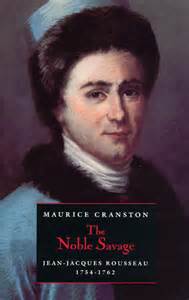
While setting the stage for the French version of liberty, equality, and fraternity, Rousseau said that savages were noble, and that humans generally were naturally and inherently good (religious opinions to the contrary notwithstanding). When asked why he would believe such a thing, in the absence of any evidence for it, he answered that the idea just popped into his head one day, which is pretty much the only available answer to that question. The idea popped into Rousseau's head, and began it's process of decimating western civilization, without his ever having lived in Africa, and long before Europe itself descended into a darkness darker than any ever seen in Africa, in the middle of the 20th century. Philosophically, this notion is pretty much sine qua non for Rousseau's process of becoming "enlightened" and "humanist", and for leading so many others to follow him in that direction.

It's hard to articulate exactly what the problems are, with Rousseau's humanism. But among them is this one: it leaves unanswered the question, when life proves to be full of problems, at whom are we going to point our fingers of blame? After all, everybody else is naturally and inherently good, just like we are. So where in the world is all of this "evil" coming from? Since Rousseau, the best available answer from his point of view has generally been, "Don't ask, it's an embarrassing question". ...continue reading

worship_12

by Barry King

President Obama called recent years of record federal spending, including billions of Keynesian "stimulus" using borrowed money, "mindless austerity" - as though if he had his way such spending would be even more prodigal. That's hard to imagine, but he can apparently imagine it. Americans are consuming all of their income, and then consuming more and spending more long after they should stop, They are able to continue that for now only by borrowing from China, leaving it to their grandchildren to repay those loans to China with interest. That can't continue much longer, and the only reason it can happen at all is because 21st-century Chinese, unlike 21st-century Americans, produce more than they consume and save the difference, so that their net savings are available to be loaned to Americans - and invested in Africa.

If the President thinks current US federal spending can be described as "mindless austerity", that means he wants to spend even more, in support of American consumption of goods and services. And of course there may well be enough American voters who like that idea, to keep him and politicians like him in power for a while longer. In that milieu, China's surpassing the US as the world's largest and most powerful economy is not only inevitable: it will happen very quickly now, more quickly than almost anyone expects. Here in Africa, that process is more clearly visible - I have been meaning to write up a report of what I saw during a recent visit to Beira, Mozambique - but I suppose there in the USA it might remain out of sight and out of mind for a little while longer. ...continue reading

by Barry King

On June 4, 2009, only a few months into his presidency, US President Obama gave a major speech about US relations with the Muslim world, at Al Azhar University in Cairo, Egypt. Reuters reported that the President’s objective in the speech was to “repair ties that were severely damaged under his predecessor George W. Bush.” One sign of that damage was that at the end of Bush’s term, only 27% of Egyptians reported having a favorable view of the USA. Today in 2015, after the first six years of President Obama’s tenure, that approval rating in Egypt has dropped an additional 17 points, to the current abysmal 10% (according to Pew Research). That’s the real-world result, so far, of Obama’s pressing of his metaphorical “reset button”.

On January 1, 2015, only a few months into his presidency, Egyptian President Al-Sisi gave another speech in the same venue, at Al Azhar. ...continue reading

Stephen Schwartz’ 1971 musical “Godspell” featured a duet for Judas and Jesus called “It’s All For the Best” (performed on the top of the World Trade Center Towers in that youtube clip). Schwartz composed a clever play on words in which Judas and Jesus use the same phrase with opposite meanings. Judas means that he thinks elites (like himself) are entitled to have everything, while Jesus is just asserting that things will work out OK in the end, for both the proletariat and for the elites, if they want. “Godspell” the musical is based on Matthew, but in the original Godspell of John (“Godspell” is an archaic spelling of “Gospel”), ch. 12, there is a real dialog between Judas and Jesus which has some interesting parallels to the dialog written by Schwartz. ...continue reading